OPINION: Elections for people, not political parties
Updated: Jul 18, 2025
13 July 2025
By Ginnie Graham, Tulsa World
Who are elections for: the American people or political parties?
The Constitution begins with “We the People of the United States.” Not We the Federalists, We the Whigs, We the Democratic-Republicans, We the Know Nothings, We the Bull Moose, We the Dixiecrats, We the Libertarians, We the Democrats or We the Republicans.
Elections are for the American people.
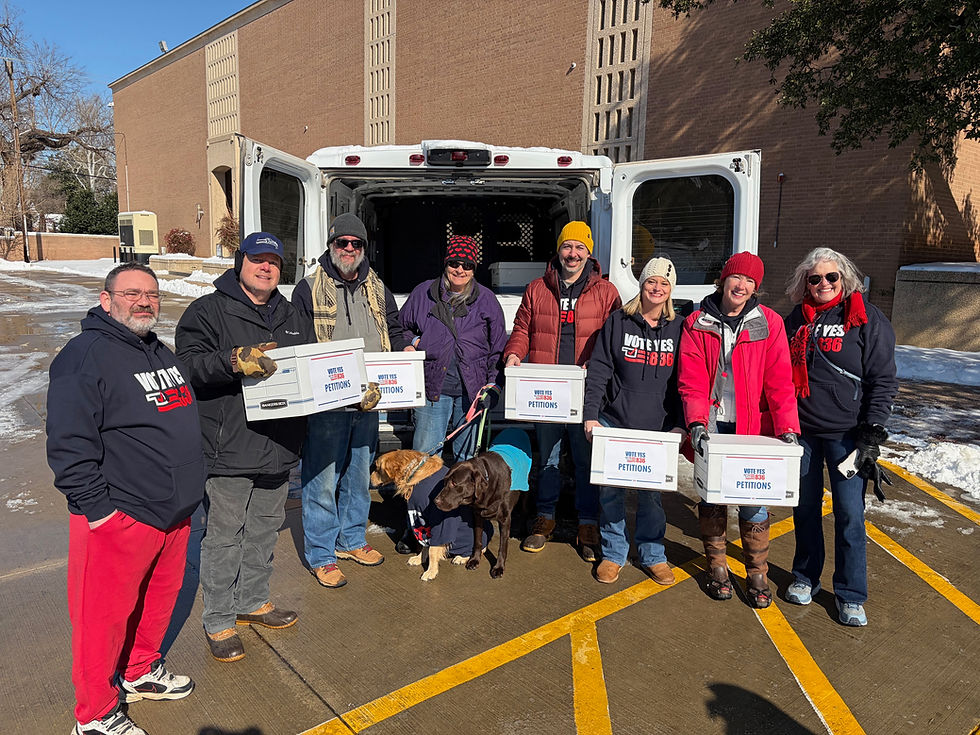
That’s what a movement in Oklahoma is seeking to restore. State Question 836 would change state elections to a unified ballot, also called a top-two primary election or open ballot. Opponents use the scary moniker “jungle primary” to refer to it, but it’s actually quite simple.
All candidates for state offices would be on a ballot — just like Oklahoma school board and municipal races — with their party affiliation noted. The top two go to the general election. It effectively ends closed primary and primary runoff elections.
This is the how the free marketplace of ideas works: Everyone gets to choose among all options. May the best candidates win.
Not surprising, the Oklahoma RepublicanParty and those benefiting off this exclusive and expensive system are running a hard court press to fight its passage. The party holds every statewide elected office and supermajorities in both legislative chambers.
The GOP went to the Oklahoma Supreme Court to get the citizen petition effort stopped, claiming it violates their rights. That decision is pending. The system works for them, so why wouldn’t they fight it?
But the state election system isn’t working for hundreds of thousands of Oklahomans. It disenfranchises voters, restricts quality candidates from consideration and forces taxpayers to pay for elections in which they cannot participate.
As election apathy has escalated, Oklahoma hit bottom in the nation for voter participation. A chief reason is a powerlessness felt by the electorate — that political parties are in control and the average voter cannot make change.
Here is what to know about the SQ 836:
Political parties can still nominate a candidate.
There is nothing to stop party bosses from putting forth and endorsing a candidate, but taxpayers are done paying for it. If a party wants to put its weight behind a candidate, then it can hold — and pay for — that process, whether from a convention, election or caucus system.
But if a person from that party wants to run, they can do that. Too many people don’t run, assuming they can’t win a primary because they don’t toe the party line. This would open the door to more candidates, not fewer.
Taxpayers save money with primary runoffs going away. The expense of primaries is significant, especially when it requires a runoff.
That happens in a field of more than two when no one gets 50%.
The last governor’s runoff was in 2018 when the Republicans narrowed the field to businessman Kevin Stitt and Oklahoma City Mayor Mick Cornett. That runoff cost taxpayers $990,242 even though only GOP voters could cast a ballot.
An open ballot would have eliminated that cost. In that scenario, it’s possible two Republicans would have been propelled to the general election because Cornett appealed to many moderate and conservative Democrats.
Local races aren’t cheap, either. Take the eastern Oklahoma Senate District 8 special election in the spring that includes portions of Creek, McIntosh, Muskogee, Okfuskee and Okmulgee counties. The race attracted six Republicans, one Democrat and one independent.
The cost of the Republican primary was $54,832 with 3,736 ballots cast, according to the Oklahoma Election Board. No one reached 50%, so a Republican runoff was held, costing $54,541, and attracted 5,206 voters. The general election cost $58,281 with 5,003 voters. In total, taxpayers paid $167,655.46 for that election. Under SQ 836, at least $54,541 would have been saved.
Oklahoma will not turn into California.
To really scare people, Oklahoma Republican leaders like to bring up the left-wing liberals coming from California, where voters approved an open ballot process in 2010. Funny how they never bring up the New York leftist liberals, who come out of same type of closed primaries Oklahoma holds.
In reality, California’s top-two primary election has been moderating. In last year’s special U.S. Senate election, the top two advancing were Democratic Congressman Adam Schiff and Republican former baseball star Steve Garvey — over third-place finisher Democrat Congresswoman Katie Porter. That’s significant considering a Republican hasn’t won a Senate seat in California since 1988.
The only real comparison between California and Oklahoma are strongholds by a single political party. In California, Democrats outnumber Republicans roughly 2-to-1 in voter registration with the party holding a supermajority in state offices. In Oklahoma, the GOP has the supermajority and outpace Democrats in voter registrations by 2-to-1.
The other two states with a top-two primary system are Nebraska and Washington, states hardly known for liberal politics.
Oklahoma is not going to become a liberal state with this ballot system.
Oklahoma has deep roots in conservatism. Even when Democrats held a supermajority back in the day, voters always backed Republican presidents. The last Democratic presidential candidate to carry Oklahoma was Lyndon Johnson, but Oklahomans backed Richard Nixon over John F. Kennedy in 1960.
The 2024 Tulsa mayoral race is not an example of how an open ballot shuts out Republicans.
Read more at Tulsa World.